The Golden Age
St. Mesrob and the Golden Age of Armenia
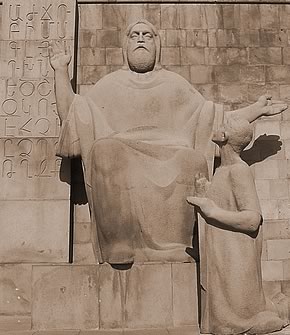
The Armenian Kingdom gradually fell into decline, yet Christianity in the land grew stronger and more deeply rooted. During this time, the urgent need arose to restore the lost Armenian alphabet. Church services were conducted in Greek; the Royal Court and nobility used Greek and Parthian; and priesthood, schools, and scholarly institutions relied heavily on Greek and Syriac. Thus, recreating a distinct alphabet became essential to prevent cultural and spiritual assimilation.
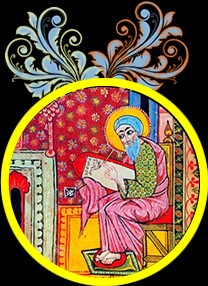
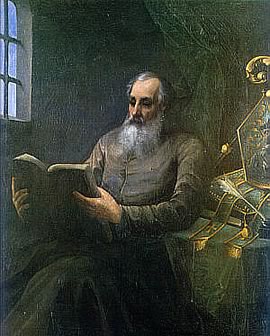
King Vramshapouh and Catholicos Sahak Partev entrusted this mission to Mesrob Mashtots, a brilliant scholar-monk. For several years, he traveled throughout Greater Armenia, Lesser Armenia, and the Mediterranean world in search of ancient Armenian texts. In Edessa, he discovered several scrolls written in old Armenian. After examining them and exploring linguistic possibilities, he successfully recreated the Armenian alphabet in 405 AD.
In 425, the Bible was translated into Armenian from authentic copies brought from Constantinople and Edessa. This Armenian version became the fifth known translation of the Holy Scriptures—preceded only by Syriac, Latin, Coptic, and Abyssinian versions. Many scholars consider this translation, produced by St. Mesrob and his disciples, to be the finest Bible translation ever made. Nineteenth-century French linguists even praised it as the “Queen of Translations.”
St. Mesrob, later canonized, is traditionally regarded as the author of the early Georgian alphabet as well. He also created an alphabet for the Gargarean tribes living in Aghuank.
Paradoxically, although the 5th century was marked by profound political setbacks, it became the Golden Age of Armenian literature. The works of Faustus the Byzantine, Moses of Khorene, Eliseus, Koriun, Lazarus Barbedzi, Eznik of Kolb, David the Invincible, and others stand as enduring monuments of historiography, theology, and philosophy.
St. Vardan and the first war for the Christian faith
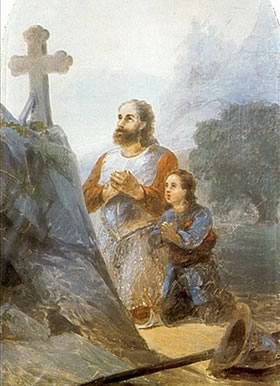 St.Vardan before the battle of Avarayr, fragment of 1892 painting by Ivan Ayvazovsky
By this time, Armenia had lost its independence. For roughly two centuries, the eastern provinces fell under the rule of Persian marzpans. Several uprisings broke out during this era, the most renowned being the Vardanank—the War of St. Vardan—in 451, vividly described by Eliseus and Lazarus Barbedzi.
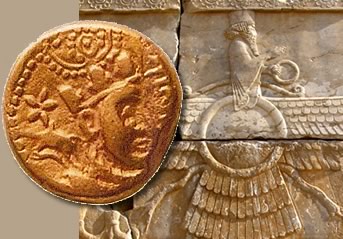
The Persian king Yazdegerd II sought to eradicate Christianity in Armenia and impose the Zoroastrian creed. The Armenian nobility revolted when numerous Persian priests arrived to erect fire temples and propagate Zoroastrian worship.
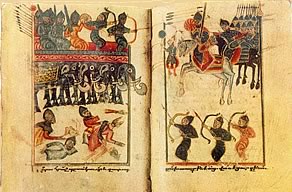
On May 6, 451, a devastatingly bloody battle was fought on the plain of Avarayr. Sixty-six thousand Armenians faced the vastly superior Persian army with extraordinary valor. Most Armenian nobles, including St. Vardan, were killed. Yet despite the military defeat, Armenia achieved a decisive moral victory: more than sixty thousand Persian soldiers perished, and Yazdegerd’s ambitions were thwarted. This is regarded as the first recorded war fought in defense of the Christian faith.
Vahan Mamikonean
Thirty years later, another uprising arose—this time led by Prince Vahan Mamikonean, the nephew of St. Vardan. Vahan fought Persian King Firuz II with alternating victories and setbacks. Firuz’s successor proved far more moderate and ultimately granted Armenians freedom of worship. Vahan was then appointed marzpan of Armenia.
Another member of the illustrious Mamikonean family, known as Red Vardan, rebelled against Persian rule in the following century. He captured Dvin, the ancient Armenian capital, but the revolt was soon crushed, and Vardan fled to Greece.
In 551, Moses, the Armenian Catholicos, established a new Armenian calendar beginning from AD 551.