From 1820 to 1914
Uprisings in the Ottoman Empire
The 1820s and 1830s were marked by widespread uprisings of non-Turkish peoples throughout the Ottoman Empire. Greece won its independence in 1829. The Serbs, Bulgarians, Albanians, and Armenians also moved toward throwing off Turkish domination. The collapse of the declining empire seemed imminent, but European powers were unable to agree on how to divide spheres of influence, allowing the Turks to retain control.
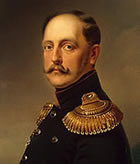 Portait of Nicolas I, by Franz Krüger, 1852. Once again, Armenians leaned their hopes toward Russia. During the Russo-Turkish War of 1829, Czar Nicholas I captured Erzerum and advanced toward Constantinople, but European pressure halted the Russian offensive. Ironically, just three years later, Russia intervened militarily to assist the Ottoman Sultan against Egypt. Such inconsistent policies weakened Russia’s long-term prospects in the region. Meanwhile, England, Germany, and France—though sympathetic to the oppressed nations—prioritized limiting Russian influence, a stance that ultimately benefited the Ottoman Turks.
First Armenian Political Parties
In the decades that followed, the Ottoman rulers introduced a broad program of reforms called the Tanzimat (“reorganization”). These reforms attempted to modernize Turkey and give it a more “European” appearance. For nearly thirty years, the Tanzimat influenced all aspects of political and social life. For the oppressed peoples of the empire, it stimulated a new wave of national-liberation movements.
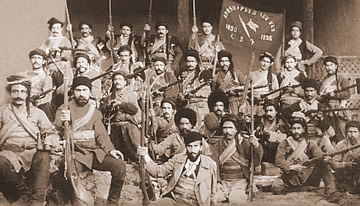
Uprisings in the Balkans and the worsening condition of Armenians prompted Russian intervention in the war of 1877–1878. After the Treaty of San Stefano, Russia gained control over large parts of Armenia and secured independence for Romania and Serbia. Yet under intense British and German pressure, Russia was forced to retreat. The treaty was revised, and Czar Alexander II withdrew Russian forces from Armenian territories.
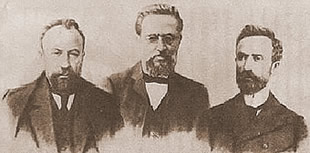
The accession of the despotic Sultan Abdul-Hamid II in 1876 ended the Tanzimat era. Nevertheless, the Armenian liberation movement continued to grow. Three major Armenian political parties—the Hnchak, Dashnaktsutiun, and Ramkavar—were established during this period.
Massacres of Abdul-Hamid
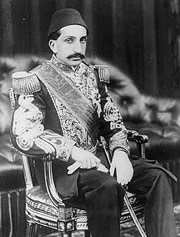
From 1894 to 1896, Abdul-Hamid oversaw systematic massacres aimed at crushing Armenian aspirations for freedom. The Sultan regarded the Armenian population as a pretext for European—and especially Russian—intervention. Government-instigated assaults on Armenian towns and villages spread rapidly across Western Armenia.
Armed resistance erupted in several regions, particularly in Zeytun, but uprisings were brutally suppressed. More than 200,000 Armenians were killed in these bloody pogroms. Historians would later call Abdul-Hamid the “Red Sultan.”
The Young Turks and the Massacres in Adana
During this same era, a new opposition group—the Young Turks—rose within the empire. Preaching attractive slogans such as “fraternity” and “common homeland,” the Young Turks deceived many Armenians into believing in the possibility of an autonomous Western Armenia. Armenian political parties and leaders supported the Young Turks financially and spiritually as they struggled against the Red Sultan.
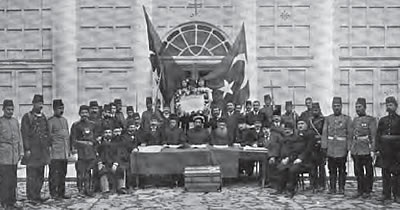
After the Young Turk Revolution of 1908, Sultan Abdul-Hamid’s authority was drastically reduced. Though he attempted a counterrevolution, the Young Turks consolidated power. Abdul-Hamid was forced to abdicate in 1909 and placed under house arrest. His successor, Mehmed V, was a puppet ruler under their control. The Young Turks then organized their powerful political movement, Ittihad ve Terakki (“Union and Progress”).
Their victory ended Armenian illusions instantly. In 1909, horrific massacres broke out in Adana, Cilicia, with Turkish mobs supported by the Ottoman army. Pogroms erupted across numerous cities. Approximately 35,000 Armenians were slaughtered. Despite promises to “restore order,” it became evident that the physical destruction of the Armenian nation was now an imminent threat.
Andranik
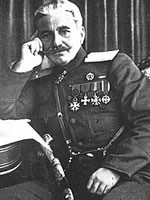 General Andranik, photographed in Paris, in 1921.
In 1912, the Balkan Wars began. Serbia, Montenegro, Bulgaria, and Greece formed a coalition against the Ottoman Empire. They achieved significant victories and forced the Turks to sue for peace.
The Armenian national hero Andranik Toros Ozanian (later known as General Andranik), fought on the Bulgarian side, forming an Armenian volunteer detachment. The Bulgarian authorities awarded him the Cross of Bravery. Later, Andranik would join the Russian Army, rising to the rank of General of the Armenian volunteer units and earning six decorations for gallantry.
The Armenians on the threshold of destruction
The First Balkan War cost the Ottoman Empire large territories, but during the Second Balkan War, internal conflicts among the Balkan allies allowed the Turks to regain much of their lost land.
In 1913, a coup within the Committee of Union and Progress brought an extreme nationalist triumvirate—Enver, Talaat, and Gemal—to absolute power. Their ideology, shaped by figures such as Zia, Dr. Nazim, and Dr. Shakir, promoted doctrines of Pan-Turkism, Turkish racial superiority, and the creation of a homogeneous Turkish state. Armenians were openly branded as dangerous, foreign, and unnecessary elements within the empire.
Armenian bankers were falsely accused of “draining the country,” and the Armenian intelligentsia was charged with undermining the state. Propaganda spread everywhere.
The Armenian nation now entered the darkest and most tragic period of its history.