The Genocide (part1)
The Turkish Plan
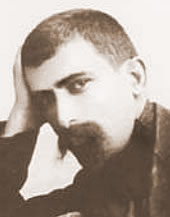
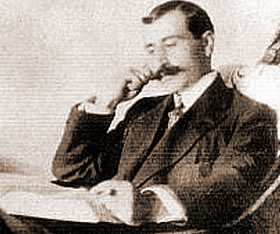
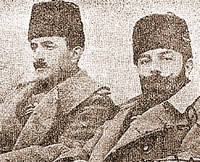 Leaders of Young Turks, Enver-Pasha (left), and Gemal-Pasha.
The outbreak of World War I in 1914 gave the Young Turks the perfect opportunity to implement their long-prepared plan to “solve” the Armenian Question. Dr. Nazim, ideologist of the Young Turks, traveled throughout the vilayets of the Ottoman Empire urging the boycott of Armenian businesses. Soon after, Enver Pasha—idol of the Turkish revolution—issued an order to form special battalions. These irregular units, composed of violent criminals and Kurdish bands, attacked, looted, and burned thousands of Armenian shops and homes in Dyarbekir.
Simultaneously, Talaat Pasha, one of the ruling triumvirs and the dominant figure in the Ottoman government, ordered the disarmament of Armenian villages. Because Muslim Turkey was at war with Christian nations, the Christian Armenians were deemed “unreliable” and suspected of sympathy toward their coreligionists. The weapons seized from Armenians were redistributed to surrounding Turkish villages.
Disarmed, arrested and executed
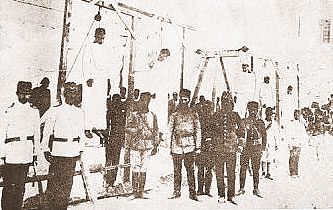
Armenian soldiers serving in the Ottoman army were disarmed, placed into forced labor battalions, and eventually murdered. Meanwhile, state-sanctioned chete units—Kurdish irregulars and criminal gangs—ravaged defenseless Armenian villages, raping women and pillaging homes.
Throughout major cities, Armenian businesses were plundered under the pretext of “war contributions.” By October 1914, mass arrests and killings were reported in Erzerum and Zeytun.
In November, after Russia declared war on Turkey, the Ottoman government proclaimed a jihad (holy war) against non-Muslims. Mass executions of Armenian soldiers occurred simultaneously with targeted killings of prominent Armenian community and religious leaders across the empire. In several provinces, Armenian bakers were absurdly accused of poisoning bread intended for the Turkish army.
Hypocricy of Turkish leaders
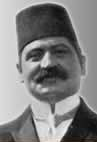 Talat-Pasha, main architect of the Genocide.
By March 1915, the Ittihad (Union and Progress) Committee had already issued a secret decree ordering the extermination of Armenians throughout the Ottoman Empire. Strict censorship was imposed, and all foreign postal offices in Turkey were closed. Even the neutral U.S. Ambassador could not receive uncensored communications from his own government.
In Constantinople, where many Europeans and diplomats resided, Turkish officials made cynical and deceitful speeches. Enver Pasha publicly praised the bravery of Armenian soldiers fighting on the Caucasus front, while Talaat Pasha met with Armenian leaders shortly before their arrest—assuring them falsely that they had “nothing to fear.”
Armenian resistance
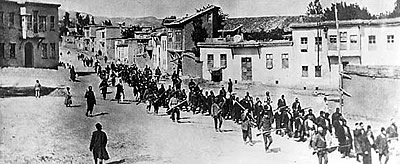
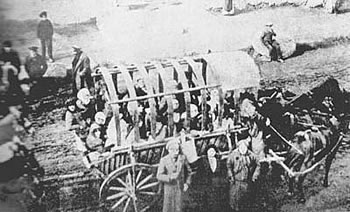 Exodus from Van, photo taken in April 1915
In April 1915, regular Turkish troops launched continuous assaults on the city of Van. Under the leadership of Aram Manukian, the Armenians organized a heroic defense. They rose in armed resistance after learning that more than 30,000 Armenians had already been massacred in surrounding villages.
The desperate defense of Van lasted 36 days. Armenians lost 55,000 men; the survivors were rescued by Armenian volunteer units serving in the Russian army on the Caucasus front. Soon afterward, a small group of unarmed Armenians mounted a last-stand defense in Shabin-Karahisar, the birthplace of General Andranik.
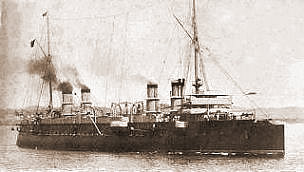 The French warship Guichen participated along with several cruisers in the rescue of Armenians who had taken shelter on Musa Dagh.
Another striking example of heroism was the defense of Musa-Dagh (Moses Mountain) in Cilicia—later immortalized by Austrian writer Franz Werfel in his novel The Forty Days of Musa Dagh. The Armenians of six villages took refuge on the mountain and resisted repeated attacks by Turkish forces for forty days. The survivors were ultimately rescued by French warships and evacuated to Egypt.