History of Karabakh (part 1)
Artsakh and Karabakh
There are several popular etymologies for the name Artsakh. According to ancient Armenian tradition, the forefather Hayk granted this land to his first-born son Aramanyak. Aramanyak planted the territory with countless trees and gardens, and thus it became known as Ar-tsakh—the “Woods of Aramanyak,” where tsakh means “woods” in Armenian and Ar is an abbreviation of Aramanyak. Given the region’s heavily forested and mountainous landscape, another version identifies Ar with Sar (mountain).
The name Karabakh first appears in Persian sources of the late 14th century following the incursions of Turkish nomadic tribes. “Kara” means black, and “bakh” means garden in Turkish—likely referencing the devastated condition of the land after invasions.
Azokh
Like the rest of Armenia, Artsakh was among the earliest centers of human civilization. Archaeological excavations throughout the region revealed numerous Paleolithic and Neolithic settlements. Notably, the skeletal remains of a Neanderthal were discovered in the Azokh Cave.
Artsakh: A province of Greater Armenia
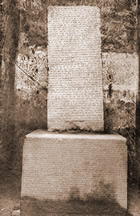
Artsakh appears in the cuneiform inscriptions of King Sardur of the Kingdom of Ararat (Urartu) in the 8th century BC. Two centuries later, Ararat was conquered by the Medes, and afterward became part of Armenia under Persian rule until regaining independence in the mid–2nd century BC. In 149 BC, King Vagharshak established the Armenian Arshakid dynasty.
According to tradition, Vagharshak enacted major social reforms, reorganized the royal court, and introduced a feudal hierarchy. He appointed Prince Aran—a descendant of Hayk—as governor of Armenia’s eastern provinces. Known for his gentle character, Aran was nicknamed Aghu (kind, gentle). Armenian historians refer to his vast domain as Aghuank (Albania in Greek and Roman sources), while Persian texts often use “Aran.” This domain included the Artsakh Principality.
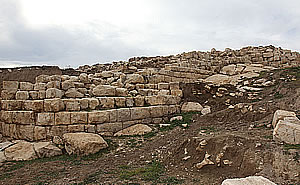
Ancient authors, including Strabo, mention Artsakh as a province of Greater Armenia. In the 1st century BC, during Armenia’s golden age, Tigranes the Great founded the city of Tigranakert near modern Aghdam—one of four cities bearing that name.
Amaras
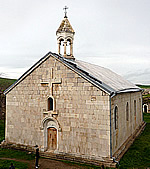 Amaras Monastery, built in 4th century
After the Christianization of Armenia in the early 4th century, Gregory the Illuminator founded the first church in Artsakh near the small river of Amaras. By the 5th century, it became a prominent monastery. After St. Mesrob created the Armenian alphabet in 405 AD, numerous schools opened in Artsakh, making the region a center of Christian learning and culture.
Aguank
In 387, Armenia was divided between Persia and Byzantium. The Persian-controlled portion was reorganized into satrapies, with Artsakh and Utik incorporated into the satrapy of Aghuank. Armenian satrapies were governed by marzpans. Armenian historians frequently used the name Aghuank to refer to the entire region.
The Princes of Artsakh took part in the great Anti-Persian uprising of 451 AD—Vardanank—the first recorded war for freedom of worship in world history.
Vachagan the Good
In the late 5th and early 6th centuries, Aghuank (the Armenian provinces of Artsakh and Utik) grew strong enough that some of its rulers proclaimed themselves kings. The heads of the Aghuank Diocese, originally appointed by the Armenian Catholicoi, began calling themselves Catholicos of Aghuank.
The region reached particular prosperity under Vachagan the Good, a descendant of the Aran dynasty. His lineage continued to dominate during the 7th and 8th centuries, even under Arab occupation. Due to its rugged and inaccessible terrain, Artsakh enjoyed relative autonomy compared with other Armenian regions.
The Arab invasions
In the 9th century, widespread uprisings across Armenia prompted Arab rulers to adopt harsher measures. Between 852–854, the Arab commander Bugha—known for his cruelty—invaded the Armenian highlands, capturing numerous nobles before advancing into Artsakh, where he encountered fierce resistance.
Isaiah, the valiant Prince of Artsakh, became Bugha’s most determined opponent. According to Thomas Ardzrouni, Bugha launched 28 assaults against the impregnable fortress of Gtich, Isaiah’s stronghold. Although the Arabs temporarily subdued the region, the Caliphate soon softened its policies toward Armenia.
In the following decades, Armenia and its eastern provinces gradually regained de facto independence. In 885, Ashot Bagratuni was crowned King of Armenia, while Gregory the Good became the recognized King of Aghuank.
Gandzasar and Dadivank
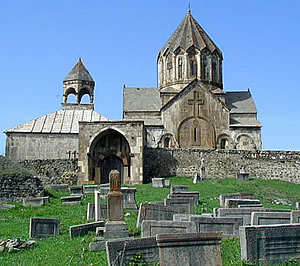
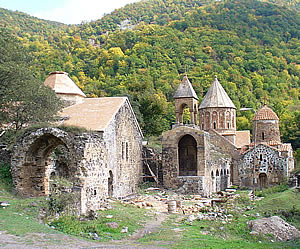
Due to its favorable geography, Artsakh escaped much of the devastation of the 11th–12th-century Seljuk invasions and the 13th-century Mongol incursions. Armenian architecture reached a magnificent peak in the early 13th century, producing some of its greatest masterpieces. The most splendid among them were the monasteries of Gandzasar and Dadivank.
Yet in the 14th century, new waves of Turkish nomadic tribes caused widespread destruction, including the devastation of many churches.
By the 15th century, Armenia had become a battleground between the Ottoman Empire and Persia. After the 1639 truce, Artsakh, along with the rest of Eastern Armenia, came under Persian control.