The First Christian Nation
Apostles in Armenia
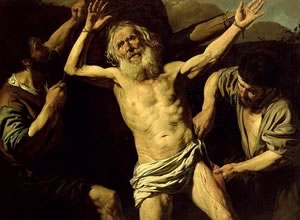 The martyrdom of St.Bartholomew, by Valentin de Boulogne
King Abgar died after ruling for thirty-eight years. Upon his death, the Armenian realm was divided in two: his son Ananun (“Nameless”) inherited the throne of Edessa, while his nephew Sanatruk ruled Greater Armenia.
During this period, the Apostles Thaddeus and Bartholomew traveled across Armenia to preach the Gospel. Their mission bore fruit—many Armenians embraced the new faith, and numerous clandestine Christian communities emerged throughout the land. Yet their ministry ended in martyrdom. Around 66 AD, Ananun ordered the execution of St. Thaddeus in Edessa. According to tradition, two other Apostles also met their end in Armenia: St. Bartholomew, who was flayed alive in Alvanapolis, and Judas (Thaddeus), who was pierced with arrows in the Artaz region.
In Armenia, Thaddeus and Bartholomew are especially revered as the first heralds of Christianity, and in their honor, the Armenian Church bears the title Apostolic.
Armenia becomes the first Christian nation
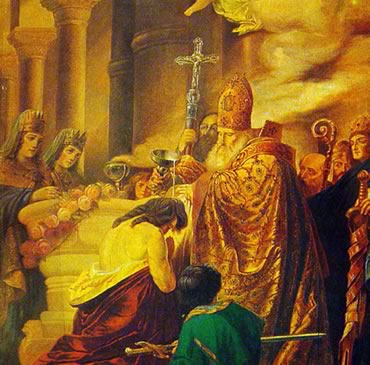
Although the Apostles planted the earliest seeds of faith, Armenia officially embraced Christianity more than two centuries later. In 301 AD, King Tiridates III proclaimed Christianity the sole state religion of Armenia. Some modern scholars argue—without firm evidence—that the date should be 314, not 301. However, historical context strongly supports the traditional date: the Edict of Milan of 313 merely granted tolerance to Christians in the Roman Empire, whereas Tiridates made Christianity the official faith of the Armenian kingdom.
Thus, Armenia became the first Christian state in world history.
The conversion of the king and court was led by Gregory the Illuminator, founder and first Patriarch of the Armenian Church. Before his conversion, Tiridates—known for his cruelty—savagely persecuted Christians. Gregory himself endured horrific tortures and was then cast into a deep underground pit infested with serpents and corpses, where he suffered for thirteen years.
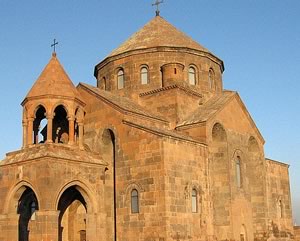
The 4th-century historian Agathangelos relates that during Gregory’s imprisonment, a group of Christian virgins led by Abbess Gayane arrived in Vagharshapat. Tiridates became infatuated with Hripsime, one of the virgins, but when she rejected his advances, he ordered the execution of the entire group. As punishment for this atrocity, the king was struck by a mysterious and incurable madness. His sister, Khosrovidukht, pleaded with him to release Gregory. When Gregory was freed, he miraculously healed the king.
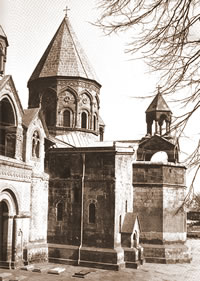
In the years that followed, Tiridates and Gregory zealously spread the new faith. Pagan temples were demolished across the country; only the temple of Garni survived the destruction and still stands today. The first Christian churches rose in Vagharshapat (Etchmiadzin), Nakhijevan, and Artsakh. According to ancient legends and the History of Moses Khorenatsi, the first cathedral of Holy Etchmiadzin—now the spiritual center of the Armenian Church—was built between 301 and 303. Its location was revealed to Gregory in a divine vision in which Christ descended to the Ararat plain and marked the site with a golden hammer.
Arshak II, Papes and Varazdat
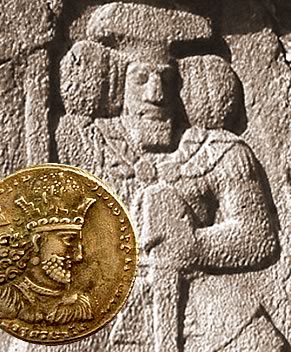
The adoption of Christianity brought profound cultural change. Pagan rituals, secular arts, and traditional poetry gradually faded. Meanwhile, Persian influence remained strong, but now Armenia and Persia followed different faiths—deepening political tension. These divisions proved disastrous.
During the reign of Arshak II, a series of wars weakened Armenia. The Persian king Shapur II succeeded in sowing discord between Arshak and his powerful feudal nobles, the nakharars, some of whom betrayed their king and defected to Persia. Summoned to the Persian court, Arshak was imprisoned for life in the infamous Castle of Oblivion. His wife, Queen Parandzem, heroically defended the fortress of Artagers for fourteen months, but was eventually captured, taken to Persia, and executed.
Arshak’s successor, King Pap, was as complex and controversial as his father. He was eventually assassinated on the orders of Emperor Theodosius I, partly because he was accused of poisoning Catholicos Nerses the Great. Since Pap’s sons were too young to rule, Theodosius appointed Varazdat, Pap’s nephew, to the throne.
Varazdat was admired for his beauty, strength, and skill—he was even a victor at the Olympic Games in Olympia, Greece. Yet his reign ended in misfortune. His plan to marry a Persian princess enraged Theodosius, who saw an alliance with Rome’s enemy as treachery. The emperor therefore ordered Varazdat to be seized, chained, and exiled to a distant island.