History of Karabakh (part 2)
The Meliks
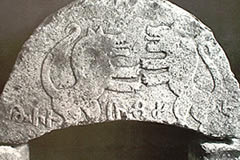 Coat of arms of the Melikdom of Gyulustan
From the late 16th century, the Armenian princes of Artsakh—known as the Meliks of Karabakh—began forming military alliances. Five of the most powerful Melikdoms united into the federation known as the Country of Five:
-
Melik of Gulistan
-
Melik of Dizak
-
Melik of Varanda
-
Melik of Khachen
-
Melik of Dgeraberd
For over two centuries, the Meliks led the Armenian national-liberation struggle in Artsakh. Meanwhile, spiritual leaders of the region made persistent diplomatic efforts to secure the support of Russia and major European powers. Renowned Armenian patriot Israel Ori spent many years traveling across Europe seeking Christian assistance—yet without significant results.
Khanate of Karabakh
In the 1720s, as Turkish forces advanced eastward, Armenians of Karabakh and Siunik united under the leadership of David-Bek. With support from Mkhitar Sparapet, he organized a successful defense that kept Karabakh and Siunik under Armenian control.
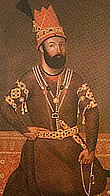 Portrait of Shah Nadir, by unknown author, from Victoria & Albert Museum, London
Although some Persian rulers, including Nadir Shah (1732–1747), occasionally supported the Meliks, Persian policy shifted in the mid-18th century. The Zand dynasty backed the nomadic Sarijalli tribal leaders, who carried out systematic raids on Artsakh.
A tribal chief named Panah-Ali captured the fortress of Shushi and proclaimed himself Khan. His son Ibrahim Khan exploited internal disputes among the Meliks and seized the monastery of Gandzasar, gradually subjugating all of Artsakh and establishing the Khanate of Karabakh.
The Russian expansion
The Persian–Turkish domination lasted until the early 19th century. As the Russian Empire expanded southward, Persia was compelled to cede much of the Caucasus—including Karabakh.
The Treaty of Gulistan (1813) formalized Russian control. In 1826, Czar Nicholas I launched a new war against Persia. That same year, Persian forces besieged Shushi. Armenian villagers and volunteers, alongside a small Russian garrison, mounted a heroic 48-day resistance, forcing the Persian army to retreat.
The war ended in 1828 with Russia’s acquisition of the Yerevan and Nakhichevan Khanates. Thus, Eastern Armenia, including Artsakh, was definitively incorporated into the Russian Empire.
Shushi
Under the 1840 Russian administrative reforms, Karabakh was included in the Caspian Guberniya. The 1867 ukase later attached it to the Elizavetopol Guberniya.
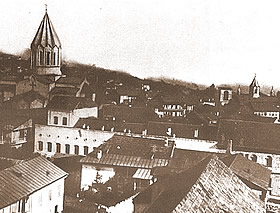
Shushi—declared a city in 1847—rapidly grew into one of the Caucasus’ most important cultural and commercial centers. Trade flourished, and Shushi became a beacon of Armenian culture, education, and printing. Before 1917, twenty-two newspapers were published there—twenty in Armenian and two in Russian.
Claims to Armenian lands
The Russian Revolution of 1917 abolished the imperial administrative divisions of the Caucasus. In March 1918, Armenian, Georgian, and Muslim leaders formed the short-lived Transcaucasian Confederation. The union quickly dissolved due to deep conflicts among the three peoples.
With Russian forces withdrawn, the region was left defenseless against Turkish aggression.
On May 27, Azerbaijani representatives proclaimed the Musavat Republic of Azerbaijan, immediately claiming the entire territory of the former Elizavetopol Guberniya. Turkish commander Nun Pasha issued an ultimatum to the Armenians of Karabakh demanding submission. In August, the Armenian National Congress of Karabakh unanimously rejected the ultimatum.
The Turkish invasion in Baku and Shushi
In September 1918, Turkish forces stormed Baku, committing widespread massacres of Armenian civilians. Soon after, the Turkish army entered Shushi.
As war loomed, Armenian volunteer forces under General Andranik advanced toward Karabakh. However, British Commander General Thompson ordered him to halt, assuring him that the matter would be resolved at the upcoming Paris Peace Conference.
In the summer of 1919, relying on British guarantees and hoping to prevent further massacres, the 7th Congress of Armenians of Karabakh temporarily acknowledged Azerbaijani authority—pending an international decision.
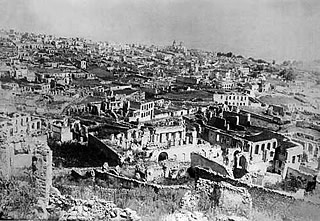
Shushi destroyed
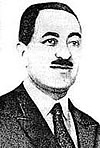
Britain soon withdrew from the Caucasus, and the Paris Conference produced no resolution. With a free hand to act, the newly appointed Azerbaijani governor-general Sultanov issued another ultimatum demanding immediate annexation of Karabakh. Armenians rejected this.
In March 1920, after brutal fighting, Turkish–Azerbaijani forces invaded Shushi. Approximately 10,000 Armenians were massacred, and the city was burned to the ground. The arrival of Armenian forces saved the remaining population from complete annihilation.
On April 23, 1920, the 9th Congress of Armenians of Karabakh proclaimed Nagorno-Karabakh an integral part of Armenia.
Bolsheviks in Armenia
Everything changed again with the arrival of the Russian Red Army. On April 28, 1920, Azerbaijan was Sovietized. The Soviet Republic of Armenia now received ultimatums from both Soviet Azerbaijan and Soviet Russia to withdraw Armenian troops from Karabakh and Zangezur.
In May 1920, the 11th Red Army occupied Karabakh, declaring it a “contested territory”—a temporary status that masked its true political ambitions.
Meanwhile, the First Republic of Armenia—already under simultaneous Turkish and Bolshevik assault—was collapsing. Despite treaties such as Sèvres, which obligated Turkey to return Armenian lands, no physical support arrived.
On November 29, 1920, Armenia became a Soviet Republic. Astonishingly, the next day the Soviet government of Azerbaijan sent a telegram to the new Armenian Soviet authorities declaring Karabakh, Nakhichevan, and Zangezour “integral parts of Soviet Armenia.”
The message, signed by Narimanov and Guseinov, urged that this “decision of Azerbaijan” be conveyed to the “fraternal Armenian people.”