History of Karabakh (part 5)
Armenians withstand Azeri attacks
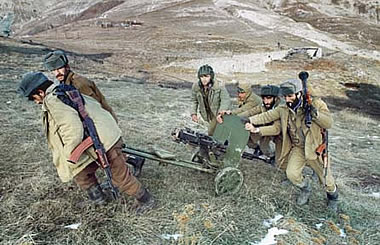 Armenian fighters move in to secure the Lachin corridor.
The summer of 1992 proved decisive. Despite severe losses, Armenians successfully resisted intense Azerbaijani assaults along all major fronts. Azerbaijani forces made extensive use of bomber aircraft, often flown by Russian and Ukrainian mercenary pilots. The dropping of internationally forbidden cluster munitions on Armenian villages became routine.
In autumn 1992, Azerbaijan launched a major attempt to retake Lachin, but was repelled. Armenian counterattacks pushed the fighting into the Kubatli region of Azerbaijan. Nevertheless, much of Mardakert remained under Azerbaijani control.
Monte
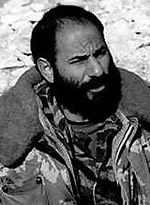 Monte Melkonian (Avo), fell in battle in June 1993.
A new Armenian counteroffensive began in February 1993. After fierce engagements, Armenian forces regained control of the Sarsang Reservoir. In March, the NKR Army launched the Kelbajar operation, successfully completing it in April. Azerbaijani forces retaliated with powerful assaults from the east, but the defense of the Martuni region—organized and led by Monte—held firm. His extraordinary bravery, strategic insight, and devotion to the struggle for Artsakh elevated him to the rank of a legendary Armenian hero.
The liberation of Mardakert on June 27, 1993 marked a major turning point. The next strategic goal became the neutralization of the heavily armed Azerbaijani stronghold in Aghdam. At the outbreak of the conflict, Aghdam had been transformed into a vast military base filled with weapons and ammunition.
On July 23, Aghdam fell. For the first time in 18 months, the residents of Stepanakert and Askeran were able to resume a semblance of normal life after nonstop bombardment.
Armenians advance
In August 1993, major operations were carried out in the Hadrout region, which Armenian forces liberated on August 26. By the end of the month, the regions of Djebrail and Kubatli also came under Armenian control.
Facing continuous defeats, Azerbaijan temporarily withdrew its forces, leading to a 45-day lull. When Azerbaijan resumed its offensive—attempting to retake strategic positions in Hadrout—its forces were repulsed yet again. Armenian forces then pressed forward, ultimately liberating the Zanguelan region.
In February 1994, Azerbaijani forces made one final attempt to break Armenian defenses in northeastern Nagorno-Karabakh. Their attack failed. In April, Armenian fighters secured several critical heights in the Mardakert region, firmly stabilizing the front.
To this day, the NKR Defense Army maintains control over most of Nagorno-Karabakh along with a surrounding buffer zone.
A cease-fire
A cease-fire agreement mediated by Russia and other CIS members was signed in Bishkek, Kyrgyzstan on May 5, 1994. The truce was reaffirmed on May 16 in Moscow at a meeting of the Defense Ministers of Azerbaijan, Armenia, and the NKR.
Since then, negotiations have been led under the auspices of the OSCE (Organization for Security and Cooperation in Europe). Its “Minsk Group” was formed to develop principles for a peaceful settlement of the conflict.
Ghukassian elected President of the NKR

In April 1995, the first parliamentary elections were held in Artsakh under peaceful conditions, forming a 33-seat legislature. In November 1996, nationwide presidential elections were held, and Robert Kocharyan was elected President of the NKR for a five-year term.
When Kocharyan accepted Levon Ter-Petrossian’s invitation to serve as Prime Minister of Armenia in March 1997, new presidential elections took place in Artsakh. In September 1997, Arkady Ghukassian—former Minister of Foreign Affairs of the NKR—was elected President with 89% of the vote.
Unrest in Armenia and Karabakh
Following the grave political crisis in Armenia in 1999—when a terrorist attack claimed the lives of eight senior officials, including Prime Minister Vazgen Sarkissian and Speaker Karen Demirchyan—an assassination attempt targeted President Ghukassian in Stepanakert five months later. He was seriously wounded.
Samvel Babayan, former Defense Minister of the NKR, was charged with orchestrating the attack and arrested along with 16 associates. He received a 14-year sentence but was released after four years.
Bako Sahakian
 Newly elected Bako Sahakian holds the certificate of election, on September 5, 2007.
The next presidential elections in Karabakh took place in the summer of 2007. Bako Sahakian—former Deputy Commander of the Karabakh Army and later Minister of the Interior—won with 85% of the vote.
He pledged unwavering commitment to securing full independence for Nagorno-Karabakh.