The First Republic
Collapse of the Transcaucasian Federation
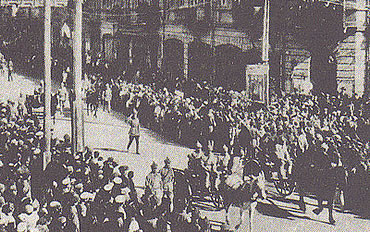
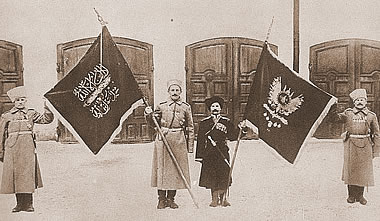 Russian troops holding captured Turkish flags at Erzerum, photo published in Britain in 1916
In February 1916, the Russian Army captured the cities of Erzurum and Trebizond. Yet Armenian hopes of liberation collapsed when Russia withdrew from World War I following the outbreak of the Russian Revolution.
The Bolshevik triumph of 1917 brought an end to the Russian Empire. In the winter of 1918, Armenian, Georgian, and Muslim leaders of Transcaucasia created the Transcaucasian Federation, which declared its separation from Russia.
The Turks, ecstatic over the collapse of Imperial Russia, saw it as a near-miracle. With Russian military power suddenly evaporating, the Caucasus front collapsed, and the fading Ottoman armies were unexpectedly revived. To stop further devastation of the new Bolshevik state, Vladimir Lenin signed the humiliating Treaty of Brest-Litovsk. Its consequences were disastrous for Armenians: Turkish forces reoccupied the lands of Western Armenia previously liberated by Russia.
By late May 1918, under the threat of a new Turkish offensive toward the Caucasus, the Transcaucasian Federation dissolved after barely three months. The Federation had been stillborn from the start: Armenian, Georgian, and Muslim delegations were divided in their loyalties. Georgians leaned toward Germany, Muslims toward Turkey, while Armenians—loyal to the Entente—were supported by no one.
On May 26, Georgia declared independence. Almost immediately, a “Musavat Republic of Azerbaijan” was proclaimed. This new Turkish-aligned state, established on traditional Armenian lands of Eastern Armenia, laid claims to Karabakh, Zangezur, and Nakhichevan.
The independence of Armenia proclaimed
Abandoned by all allies, Armenians faced annihilation. A 100,000-strong Turkish army crossed the old Russian frontier, seized Kars, and advanced toward Yerevan. Having emptied Western Armenia of Armenians, the Turkish forces were poised to exterminate the remainder of the nation.
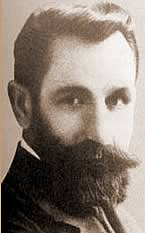
Armenians hastily assembled a force of 40,000—soldiers, officers, volunteers, and mass levies. Initially, some Dashnak leaders proposed evacuating the population and surrendering Yerevan, but the Military Council under Colonel Daniel Bek-Pirumian chose to resist.
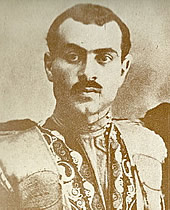
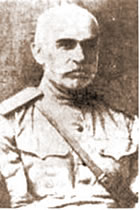 General Moses Silikyan (Silikov), commander of Armenian troops in the battle of Sardarapat.
On May 28, 1918, at Sardarapat, the two armies clashed. The battle ended in a decisive Armenian victory: roughly 30,000 Turkish soldiers were killed, and the invaders were pushed back. Vahib Pasha, the defeated Turkish commander, declared Armenian fighters to be “the best soldiers in the world.” Armenians also held the lines at Karaklis and Abaran.
That same day—May 28, 1918—Armenia declared its independence.
Yet the newborn republic was devastated: its economy shattered, tens of thousands of refugees starving, and Turkish aggression still looming. Conflict with Georgia soon erupted, while the situation in Karabakh became critical as the new Azerbaijani state issued ultimatums to the Armenian population.
In September 1918, Turkish troops seized Baku and, together with Turkish–Azeri mobs, massacred 30,000 Armenians. Surrounding Armenian villages were annihilated.
The Wilsonian borders
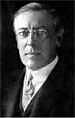 President Woodrow Wilson
Meanwhile, European powers struggled to find a solution to the Armenian Question. The Armenian government’s 1919 call for unification of Caucasian Armenia with Turkish Armenia proved unreachable. After Armenia was officially recognized by the Allies and the United States, U.S. President Woodrow Wilson was invited to define the borders of a future Armenian state. His map included most historically Armenian lands—but the plan was never implemented.
Armenia falls to the Bolsheviks
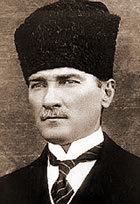
Territorial losses soon followed. Mustafa Kemal—leader of the new Turkish nationalist movement—formed an alliance with Bolshevik Russia. Inspired by their aim to “export the revolution eastward,” Lenin and Stalin quickly offered Kemal massive military and financial assistance.
At the same time, internal chaos erupted in Armenia as Armenian Bolsheviks rose in Nakhichevan, Alexandropol, and Kars. The Soviet government hypocritically negotiated with both Dashnak and Armenian Bolshevik leaders.
In August 1920, the Treaty of Sèvres—signed by England, France, and Turkey—formally recognized Armenian independence and Wilsonian borders. Most countries, including the United States, recognized the new state. But after Mustafa Kemal’s victory, the Turks, backed by Bolshevik Russia, launched another invasion of the fragile Armenian Republic.
Armenian and Russian Bolsheviks undermined the Armenian army and morale. Propaganda described Turks as “socialists” and “friends of Russia,” confusing and demoralizing the population. Meanwhile, the victorious Russian XI Red Army, having Sovietized Baku, Azerbaijan, and Karabakh, advanced toward Yerevan to “overthrow the Dashnaks.”
The Armenian army, weakened and disoriented, retreated—abandoning Kars and the district of Surmali. In the aftermath, the Armenians of these regions were massacred without mercy.
On November 29, 1920, Armenia was declared a Soviet state.
The Resistance in Zangezur and the Republic of Mountainous Armenia
The entire Zangezur region (Syunik) resisted Soviet rule. Garegin Njdeh, national hero and commander of the southern corps of the Armenian army, organized the defense against Soviet forces. In December 1920, Syunik proclaimed itself a self-governing region.
In February 1921, following an anti-Soviet uprising in Yerevan, the ARF (Armenian Revolutionary Federation) controlled the capital for 42 days before being forced to withdraw to Syunik. On April 26, 1921, an independent Republic of Mountainous Armenia was declared, with Garegin Njdeh serving as both Prime Minister and Minister of Defense.
This republic survived only three months, falling after several major assaults by the Red Army.