The Genocide (part2)
Turkish atrocities
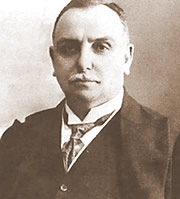
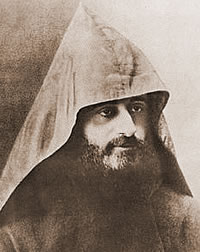
After what the Ottoman authorities cynically called the “revolution of Van,” Armenians were officially labeled “internal enemies” of the empire. In Constantinople, many of the most prominent Armenians—intellectuals, political figures, and religious leaders—were arrested and murdered. Among them were Grikor Zohrab and Vartkes Serengulian, both members of the Ottoman Parliament and widely known as personal acquaintances of Talaat Pasha.
Simultaneously, mass killings swept through Bitlis, Mush, and Dyarbekir. Detailed instructions for the deportations were dispatched to provincial governors across the empire. Armenians were ordered to prepare for “resettlement,” only to be driven on forced marches toward the Syrian deserts between Jerablus, Mosul, and Deir ez-Zor.
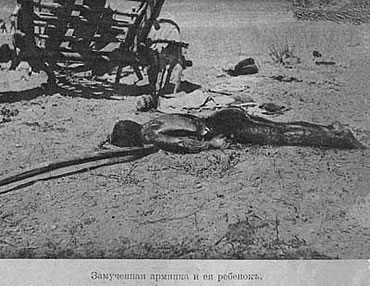
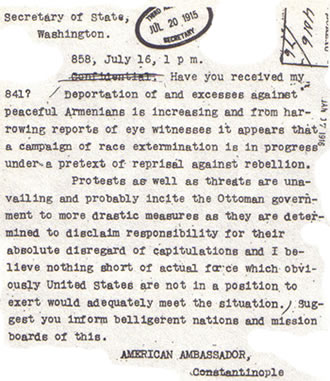
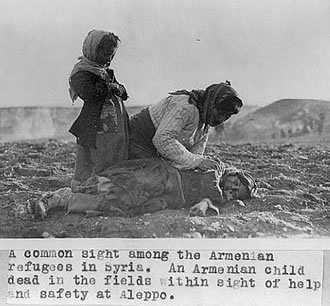
Only a fraction would survive. Many died from starvation, but most were murdered en route in the most brutal manner imaginable. An American missionary reported that during a journey from Malatia to Sivas, he saw countless mutilated corpses strewn along both sides of the road for nine continuous hours. Tens of thousands of bodies were thrown into the Euphrates River. In Trebizond, thousands of Armenians were taken out to sea and drowned.
By July 1915, virtually no Armenians remained in Van, Bitlis, Dyarbekir, Sivas, Erzerum, or Trebizond. A small number of orphaned boys were forcibly converted to Islam and adopted into Turkish families. Shortly afterward, Talaat Pasha boasted to the German Ambassador that “the Armenian Question has been solved.” The depopulation of Western Armenia was, in Ottoman terms, “successfully completed.”
Deportations continued
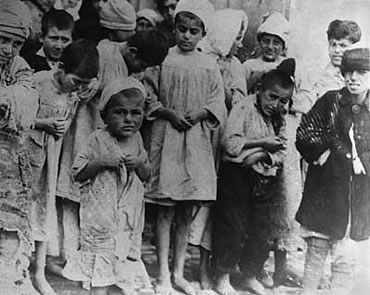 Armenian orphans.Source: http://centerar.org
In 1916, deportations and massacres intensified with relentless cruelty. New directives were issued to eliminate Armenian orphans who had survived earlier atrocities. Those who remained alive were subjected to forced Islamization. Most who reached the Syrian deserts perished from hunger, disease, or direct slaughter.
In October 1916, the German Ambassador Wilhelm Radowitz reported to Berlin that out of an estimated two and a half million Armenians in the Ottoman Empire, only about 300,000 were still alive. The rest had been killed or deported; a portion had managed to escape into the Caucasus. The ambassador’s figure of “two and a half million” likely followed the falsified Ottoman census of 1887 under Sultan Abdul-Hamid. The true Armenian population was almost certainly higher.
End of Young Turks
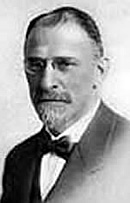
Governments of Europe and the United States condemned the Genocide. U.S. Ambassador Henry Morgenthau wrote:
“…the whole history of the human race contains no such horrible episode as this. The great massacres and persecutions of the past seem almost insignificant when compared to the sufferings of the Armenian race in 1915.”
The Ittihad (Union and Progress) Cabinet resigned in October 1918. The triumvirate and their associates fled Turkey. Courts-martial later sentenced Enver, Talaat, Jemal, and Dr. Nazim to death in absentia. Kemal Bey, responsible for the Yozgat massacres, was publicly executed. Rashid Bey, the governor of Dyarbekir and a principal architect of the killings, committed suicide. Other perpetrators received prison terms; some were later released, while others joined the forces of Mustafa Kemal.
Despite international condemnation, the Armenian Genocide was never officially acknowledged by the Turkish government. To this day, Turkish authorities continue to deny its historical reality.
Retribution
Several principal orchestrators of the Genocide were later assassinated by Armenians:
-
Talaat Pasha, one of the main architects of the Genocide, was assassinated in 1921 in Berlin by Soghomon Tehlirian.
-
Enver Pasha fell in 1922 in Tajikistan, killed by an Armenian combatant.
-
Jemal Pasha was assassinated in 1922 in Tiflis by Stephan Tzagikian and other Armenian avengers.
-
Cemal Azmi (governor of Trebizond) and Behaeddin Shakir, one of the leading propagandists of extermination, were both assassinated in 1922 in Berlin.