USSR (part 2)
The new wave of Armenian migration
In 1946, many patriotic Armenians from diaspora communities chose to repatriate to their ancestral homeland, hoping to contribute to post-war reconstruction. However, in 1948–1949, Stalin launched yet another wave of political repression. Thousands of these repatriated Armenians were illegally arrested and deported to Siberia and the Altai region.
Beginning in the 1960s, Armenians once again began emigrating from the Soviet Union on a large scale. Soviet authorities classified Armenians—along with Jews and Germans—as “unreliable elements,” which further restricted their opportunities and created pressure to leave.
Rebirth of Armenia
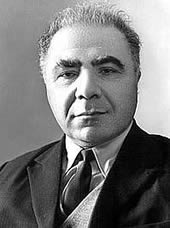
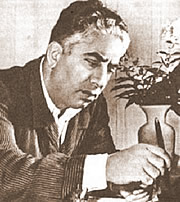 Composer Aram Khachaturian, the iconic figure in Armenian music.
After Stalin’s death in 1953, Soviet leader Nikita Khrushchev initiated the policy of de-Stalinization, easing the suffocating grip of state terror. Cultural and intellectual life began to liberalize. Almost immediately, Armenia experienced a period of cultural and economic revival.
Numerous Armenians rose to prominence across the Soviet Union, including:
-
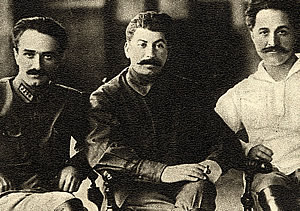
Anastas Mikoyan — influential political leader and statesman
-
Artem Mikoyan — aviation engineer, co-founder of the MiG fighter aircraft design bureau
-
Aram Khachaturian — world-renowned composer
-
Viktor Hambartsumyan — one of the greatest astrophysicists of the 20th century
Vazgen I
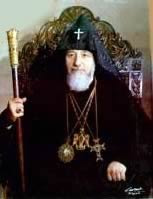 Vazgen I, Catholicos of All Armenians
During this period, Armenia enjoyed slightly more religious freedom than many other Soviet republics. When Catholicos Vazgen I assumed office in 1955, he pursued a relatively independent religious policy, gradually strengthening the autonomy of the Armenian Church under Soviet rule.
He preserved numerous church treasures, founded new institutions and museums, restored ancient Armenian churches, and expanded ties with the Armenian diaspora.
The Genocide commemorated
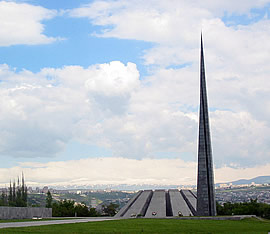
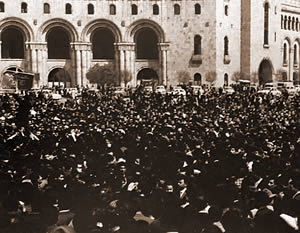
On April 24, 1965, Armenians worldwide held mass gatherings to mark the 50th anniversary of the Armenian Genocide. In Yerevan, large demonstrations occurred; Soviet troops entered the city to maintain control. Despite official unease, a major memorial dedicated to the victims of 1915–1921 was erected shortly thereafter. Since then, April 24 has become an enduring day of remembrance for Armenians everywhere.
Armenian organizations abroad intensified efforts to gain international recognition of the Genocide. During the 1970s, secret groups such as ARA (Armenian Revolutionary Army) and ASALA (Armenian Secret Army for the Liberation of Armenia) emerged. Frustrated with the limited impact of peaceful protests, these groups turned to violent tactics, carrying out attacks against Turkish officials in several European countries to draw global attention to the Armenian cause.
The Karabakh Question
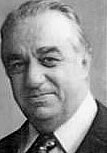
The Armenian national movement also manifested in petitions from the Armenians of Nagorno-Karabakh, demanding reunification with Armenia. From 1967 to 1970, Soviet authorities examined the issue while Armenian First Secretary Anton Kochinyan held fruitless negotiations with Azerbaijani leaders Akhundov and Aliyev.
In 1977, the question of Nagorno-Karabakh was raised again—but was once more shelved without resolution.
Karen the Builder
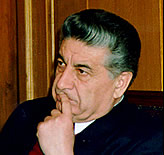 Karen Demirchyan
Under Karen Demirchyan, First Secretary from 1975, Armenia’s economic development stagnated in line with the broader Soviet economy during the Brezhnev era. Nevertheless, Demirchyan excelled in construction and urban development, earning the affectionate title Karen the Builder. His initiatives transformed the architectural landscape of Armenia—especially Yerevan—and contributed to the republic becoming one of the most urbanized regions in the USSR.