Fall of Greater Armenia
Ani, Golden Era of Armenia
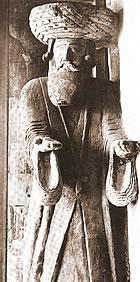 Relief of King Gagik I, from the Cathedral of St.Gregory, in Ani.
During the reigns of Kings Abas I (928–951), Ashot III the Merciful (952/953–977), and his sons Smbat II (977–989) and Gagik I (990–1020), Armenia reached the height of its golden era. All of these kings ruled from the capital Ani, famed as “the city of one thousand and one churches” and “the city of forty gates.”
Due to its vast size, military strength, and immense wealth, Ani became one of the greatest cultural and economic centers of its age. Its churches, cathedrals, palaces, and fortifications were among the most technically sophisticated and artistically advanced structures in the world.
Tiridates, the Architect
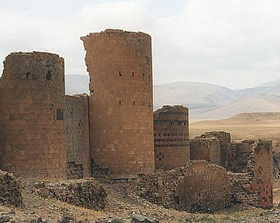
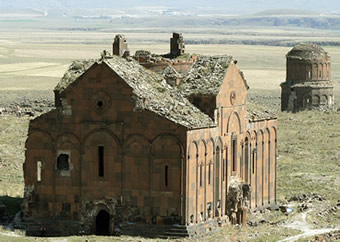 Ruins of the Cathedral and the church of Redeemer, in Ani.
Photo sourse: Flickr, Antonio
Many of the masterpieces of Ani were created by the brilliant architect Tiridates. In 990, he built the Catholicosal palace in Arkina near Ani, as well as the majestic Cathedral of Ani. European scholars—such as Joseph Strzygowski and Charles Diehl—noted that several structural features of the Ani Cathedral were architectural innovations later adopted and refined by Romanesque and Gothic builders in Europe.
The fame of Tiridates spread far beyond Armenia. In 989, he was invited to Constantinople to restore the dome of Hagia Sophia, which had collapsed after an earthquake. His reconstruction remains standing to this day.
The Turks emerge
As the new millennium approached, devastating invasions shook the region. The Seljuk Turks rose as a formidable new power. The first Armenian province to be attacked was Vaspurakan, ruled by the Ardsrouni kings. Unable to defend the land from Seljuk incursions, King Senekerim sought protection from Emperor Basil II. According to their agreement, Basil II received Vaspurakan in exchange for granting Senekerim a Greek province.
Meanwhile, the Seljuks attempted to seize the ancient Armenian city of Dvin but were repulsed by Vahram Pahlavouni, Sparapet of Armenia.
Gagik II
Over the next fifty years, the Byzantine Empire gradually annexed large portions of Greater Armenia. Caught between the growing Turkish threat and the ambitions of the Christian Byzantines, Armenia faced impending catastrophe. In 1041, the army of Constantine IX besieged Ani. The aged but valiant Vahram Pahlavouni—already 80 years old—repelled repeated assaults, forcing the Greeks to lift the siege.
Soon thereafter, sixteen-year-old Gagik II arrived in Ani and was proclaimed King of Armenia.
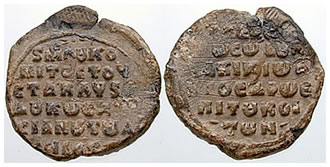 As compensation for his lost Armenian crown, Gagik II received the district of Lycandus in Asia Minor and the town of Bizou, in the vicinity of Caesarea. He was also granted the use of a palace on the Bosphorus in Constantinople and a pension from the Imperial treasury. Several seals testify Kakikios Aniotes (Gagik of Ani) as duke of the thema of Charsianon. Photo Source: English Wikipedia. Yet Gagik II was destined to become the final king of the Armenian Bagratouni dynasty. Young and inexperienced, he fell victim to betrayal by pro-Greek Armenian nobles, most notably Prince Sarkis. During Gagik’s stay in Constantinople, Emperor Constantine IX informed him that Sarkis and other Armenian dignitaries had acknowledged Byzantine authority over Armenia. Distressed and disillusioned, Gagik refused to return.
Armenia falls under the Turks
Byzantine power in Armenia collapsed in 1071 after the famous Battle of Manzikert. The Byzantine army—over 100,000 strong and including Armenian troops—met the Seljuk forces of Alp Arslan. The Christians were defeated, and Emperor Romanos Diogenes was taken captive. The Seljuks soon took control of all Greater Armenia.
Armenians and Georgians unite
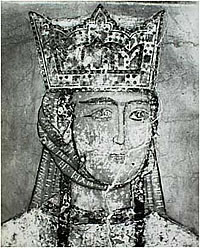 A fragment of the early 13th century fresco of Queen Tamar from Betania, Tiflis.
During the 12th and early 13th centuries, Armenian nobles joined forces with the neighboring Georgians in efforts to liberate Armenian lands. The strengthening Georgian Kingdom was at that time ruled by a branch of the Armenian Bagradouni dynasty. After uprisings in 1124, 1161, and 1174, Seljuk authority was overthrown in several Armenian cities.
During the reign of Queen Tamar (1184–1213), major Armenian cities such as Ani, Kars, and Dvin were reconquered. The military campaigns were led by the Armenian commanders Zakare Zakarian and his brother Ivane, favored generals of the queen.
Mongols and Turkomans in Armenia
This brief revival ended with the first Mongol invasions of the early 1220s. Over the next century, Armenia endured repeated campaigns of terror and destruction. Entire provinces—Ani, Kars, Lori, Gandzak, Shamkhor, Khachen, Nakhichevan, and others—were devastated, plundered, and burned.
After the 1254 census, the Armenian population was heavily overtaxed. The historian Kirakos Gandzaketsi, an eyewitness, wrote:
“…they demanded the most severe taxes, more than a man could bear… They harassed the people with incredible beatings and tortures… Those who hid were seized and killed.”
Multiple rebellions led by Armenian and Georgian nobles were crushed with extreme brutality.
By the early 14th century, Mongol power in the region faded, only to be replaced by invasions of Turkoman nomadic tribes. Different regions of Armenia became battlegrounds for rival Turkoman confederations, such as the Kara Koyunlu (Black Sheep) and Ak Koyunlu (White Sheep).